CASE STUDY: FOOD EQUITY INFORMATICS
Invincible City Farms — Camden, New Jersey — 2016–2021
THE PROBLEM
Camden, New Jersey carries one of the highest food insecurity rates in the United States. A $38 million supermarket supply gap existed not because food was unavailable regionally, but because the architecture connecting producers, distributors, and consumers had structurally collapsed. Sixty-five to seventy-three percent of residents received SNAP and WIC benefits. The redemption rate was 53%.
This is not a hunger problem. It is a data governance and systems design problem.
THE FRAMEWORK: FOOD EQUITY INFORMATICS
In 2019, Invincible City Farms developed and named a proprietary analytical framework — Food Equity Informatics — defining it as the study of the intersection of people, technology, and data to improve food access and nutritional quality within urban food deserts.
The framework proposed that ending food deserts required not more food, but better data architecture. Specifically:
— Population-specific behavioral data collection, not aggregate or county-level analysis — Agent-Based Modeling and Discrete Event Simulation to identify emergent behavior and structural disruptors in real time — GIS mapping of mobility constraints, transit access, and store proximity across community archetypes — A smartphone platform integrating SNAP/WIC benefits, personalized nutrition programs, and behavioral incentive structures — A modeling architecture explicitly designed to be portable — deployable in any food desert, not just Camden
The technology layer was the governance layer. The platform collected behavioral data to learn what the food desert population's habits and choices were around food, what influenced those habits, and what would encourage and support change — then used that data to direct interventions rather than assumptions.
INSTITUTIONAL ENGAGEMENT
In August 2019, Fredric A. Byarm Sr. brought the Food Equity Informatics framework directly to the City of Philadelphia's Office of Innovation and Technology, presenting to:
— Henry Garie, Geographic Information Officer and Chief Data Officer, City of Philadelphia — Amory Hillengas, Philadelphia Department of Public Health
The meeting was convened specifically to discuss data architecture, GIS analysis, and the governance of population-level food behavior data. The CDO's office connected Invincible City to the Health Department's GIS staff for further collaboration.
This was not a community program pitch. It was a data governance conversation at the institutional level.
THE MODEL
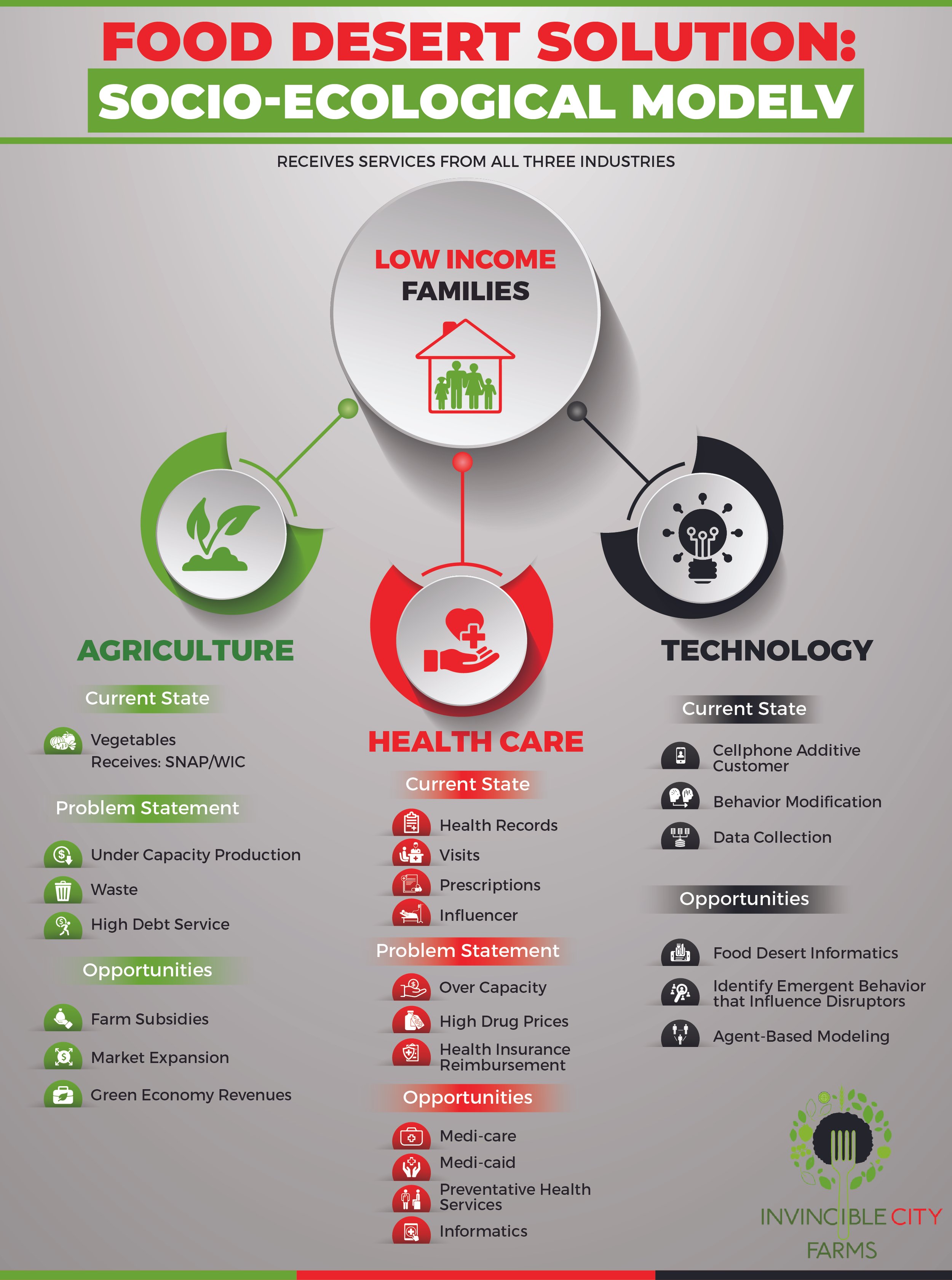
The socio-ecological model integrated three sectors — agriculture, healthcare, and technology — not as parallel programs but as a unified data-governed distribution architecture. Low-income families sat at the center as the beneficiary node receiving services from all three simultaneously.
Five community user archetypes were built from field research across Camden's neighborhoods — capturing age, income, mobility constraints, language, health conditions, shopping behaviors, and cultural patterns. These personas drove the modeling framework, ensuring interventions were built from population-specific evidence rather than generic assumptions.
OUTCOMES
Over 36 months, the Invincible City infrastructure reduced localized food insecurity rates by 18%, delivering nutritional access to more than 1,200 high-risk families annually. The model secured over $2.5 million in multi-sector capital and was presented to Senator Booker's office and the New Jersey Economic Development Authority as a replicable statewide template.
THE THROUGH-LINE
The governance questions Food Equity Informatics raised in Camden in 2019 are identical to those now defining responsible AI deployment globally: Who controls population-level behavioral data? Who benefits from predictive modeling? What accountability structures exist when a community is simultaneously the data source and the intended beneficiary? What happens when the modeling framework scales beyond the community that built it?
These questions are being formalized through the MSc in Future Governance at the Edinburgh Futures Institute, University of Edinburgh — and they continue to shape the AI governance and food systems work being carried forward through BYARM.ORG.
Fredric A. Byarm Sr. Founder, Invincible City Farms Principal, BYARM.ORG Incoming MSc Future Governance — Edinburgh Futures Institute fredric@byarm.org